



Federated learning: shared intelligence without breaching privacy
How decentralised machine learning enables banks to collaborate on financial crime detection without exposing sensitive data.
Read moreProvided by Praelexis

Federisk uses federated learning to score transactions, accounts, and clients for fraud and money laundering, across banks, without sharing a single row of data.



Private by design
Fewer false positives
Real-time scoring
Smarter than any single bank
Detects what rules miss
Built for regulators
How decentralised machine learning enables banks to collaborate on financial crime detection without exposing sensitive data.
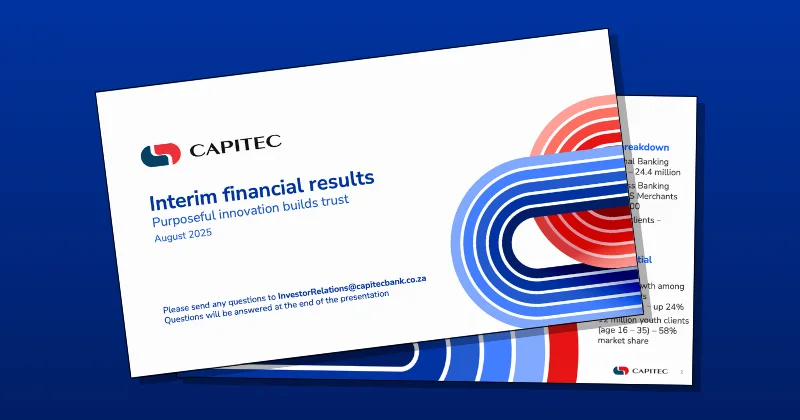
Read moreCapitec's 2025 interim results presentation, including performance data on AI-powered fraud and scam prevention across the bank's client base.
Read moreCapitec's AI-powered fraud prevention tools blocked over 23,000 scam payments, protecting clients from approximately R200 million in losses.
Read moreIn live production, Federisk achieves a ~40% precision rate on flagged cases, compared to the 0.5–10% typical of traditional rule-based and siloed detection systems. Your investigation teams spend their time on real threats, not noise.
A machine learning model trains on your bank's data, inside your secure environment. No data leaves. No data is uploaded. The model learns from your institution's unique fraud and money laundering patterns.
Data stays here. The model trains in-place, on your infrastructure, within your security perimeter.
Only the model's learned parameters (its "intelligence") are shared with the Federisk network. These parameters are abstract, uninterpretable, and privacy-safe. Data never moves.
No data crosses any boundary. What flows through the network is mathematically distilled intelligence, not transactions, not customer records.
The federated model is deployed back into your environment. It scores clients, accounts, and transactions for fraud, money laundering, and mule account activity, combining the collective intelligence of every participating bank.
Scores integrate directly into your existing case management system or risk platform. No rip-and-replace. No new data lake.