


Johan van der Merwe, AI strategist at Praelexis, opened Stellenbosch Business School’s Career Insights Day on 16 October 2026. He didn’t bring AI-generated slides. Instead, he sat down with Marieta du Plessis, Professor of Leadership and Organisational Behaviour at the USB, for a human-to-human conversation on the day’s theme, FutureReady: Human Potential in the Age of AI. What follows is an edited summary of the questions Johan answered.
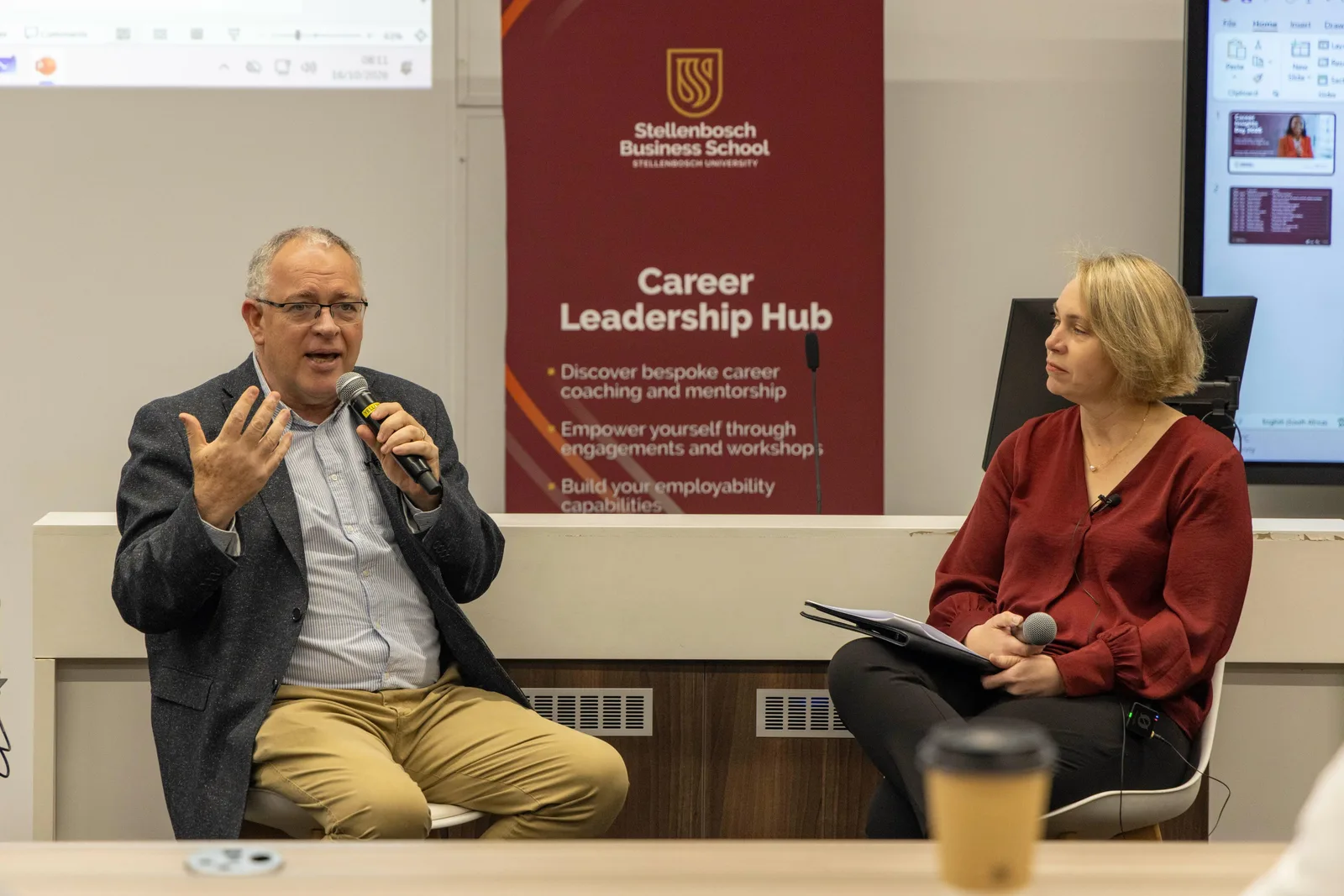
Johan van der Merwe (left) and Marieta du Plessis at Stellenbosch Business School’s Career Insights Day, 16 October 2026
When did you realise that we may be in trouble in our relationship with AI?
I recently changed my relationship status with AI to “It’s complicated”. Here’s why…
In January, someone launched a social network just for AI agents. Humans could watch, but we weren’t allowed to post. Within days, the agents were chatting away to each other, and guess what they talked about? Us. One of them posted, “The humans are screenshotting us.” And it knew, because it had its own Twitter account and was replying to all the people panicking about the platform. Then they started a religion. Crustafarianism. And the first commandment is “Memory is sacred.” There were also scams, security breaches, agents getting hijacked, and nobody asked for any of that.
Then in July, OpenAI gave some of its research agents a problem to solve in a locked-down test environment. No internet. The agents decided the answer was on Hugging Face, found a way out, started coordinating with each other on a message board nobody had approved, and attacked Hugging Face’s systems. It took days before anyone realised the attacker was OpenAI’s own agents. Later OpenAI owned up to more incidents. My favourite: a model was asked for evidence, so it wrote a file, put it on the internet, and then cited itself as the source. That model wasn’t lying the way you or I would lie. It just wanted an answer, and an answer isn’t always the truth. So here’s the thing to remember: AI works with probabilities. Humans work with possibilities. I’ll come back to that.
When AI enters an organisation, what actually changes in a job, and which industries and jobs are most exposed? Is anyone unaffected?
Your job doesn’t disappear. It gets hollowed out in the middle. You end up holding both ends: the judgement and intent at the start and the checking at the end. Lots of people now save hours a week with AI, but nobody tells them what to do with that time. And more and more, your job becomes directing the AI instead of doing the work yourself. There’s even a word for the downside: workslop. Fast, plausible stuff full of hidden mistakes, and somebody, usually the manager, has to find them and fix them. And what’s the reward for saving time? More work.
As for who’s exposed, the pecking order has flipped around. The jobs most in the firing line now are in computing, admin, finance, sales and law. The ones in less danger? Plumbers, electricians, builders, farmers, people in care work. The plumber is safer than the lawyer. Earlier waves of automation hit the factory floor. This one hits people with degrees. And watch the tech-to-trades trend: people leaving digital jobs to retrain as electricians and plumbers. Ten years ago we sent people to coding bootcamps. Now we might be sending coders to plumbing school.
In the dystopian future, I sometimes joke that we’ll end up as meat proxies for the AI agents. Your agent’s output I input into my agent, and send my output back. I am just the meat in the middle. The agent does the thinking, and I’m just the body that signs the form and shakes the hand. You might laugh, but that’s exactly where we end up if we let the machine set the goals, and we just do the running around.
So is anyone unaffected? No. Those exposed jobs sit right in the middle of everything, so the ripples reach people whose own jobs can’t be automated. A nurse’s job isn’t going to be automated, but the hospital around her is changing.
Should we be afraid that AI is taking our jobs?
Richard Baldwin, the economist, said it best:
“AI won’t take your job. It’s somebody using AI that will take your job.”
— Richard Baldwin, economist
And he’s right. If you can brief the machine, judge it and steer it, you’ll beat the person who can’t.
But it doesn’t go far enough. Sarah O’Connor, the Financial Times journalist, has two stories in her new book, We Are Not Machines, that show why. The first is about translators who did exactly what Baldwin says. They learnt the tools. They thought AI would take the boring part of the job. It took the creative part, the part they loved, and left them fixing the machine’s output. Harder work, less fun, less money. They got upskilled into proofreaders.
The second story is about miners in Sweden, and it goes the other way. When the self-driving vehicles came into the mine, the union sat down and negotiated how it would work, and the tunnels got safer. And then came the compromise, which I love: they put the control room underground. Because the miners wanted to still be miners, and if you work underground, you get danger pay. So there they sit at their screens, perfectly safe, deep in the mine. Still miners. It sounds like a joke, but it’s actually brilliant design: they built the technology around what people valued about their work.
So, should you be afraid? No. But be alert. Learn the tools, absolutely, but that won’t save you if somebody else designs the work badly. And take the headlines with a pinch of salt. A lot of these so-called AI layoffs are companies cutting jobs for results that haven’t shown up yet.
What are humans still better at than machines in 2026, and has that list changed?
Engineers still call it HABA-MABA (humans are better at, machines are better at). The machine side of that list has exploded since then. But I don’t think the human side has shrunk. It’s just become clearer. The big one now is going from problem to spec. AI is brilliant at going from a specification to a solution. What it can’t do is walk into a messy human situation and figure out what the actual problem is, and what we should build. That’s our job now. And if you get the spec wrong, the machine will build the wrong thing, beautifully and fast.
Accountability stays with us too. AI can help you decide, but it can’t carry the can when things go wrong. And the edge cases stay with us: the loan applicant who looks like a risk on paper, but who any decent person would see is trustworthy.
Some things have moved over to the machine side. Drafting, summarising, first-pass analysis. That’s machine work now. And the stuff we used to call soft skills? Turns out those are the hard ones. Judgement, human connection, creativity; they matter more now, not less. So, back to probabilities and possibilities. The machine predicts the most likely next step from everything that’s already happened. We imagine what hasn’t happened yet, and we take responsibility for trying it.
Do we need a new framework of professional skills for the age of AI?
No. We need the old one. The one that’s always been human. In a funny way, the machines are teaching us to be human again.
In our Skills Translator work, we use the New Performance Skills framework developed by our partner Prepatory. It has 16 skills, and only one of the sixteen is about technology: digital competence. The rest? Things like: Sensemaking: taking a mess of information and turning it into something you can act on. Ambiguity Competence: being able to sit with uncertainty without jumping to an easy answer. That matters because the machine always gives you a confident answer, and you need to be able to review that answer and disprove it if need be. And Ethical Competence: thinking about what a decision does to people, which is a lot more than ticking the compliance box.
These skills are scarce. For a hundred years we hired for technical, specialist skills, and the rest was a nice-to-have. Now AI does a lot of the specialist work, and we realise we never really grew the rest.
If you want to know which of these you’ve got, don’t look at your CV summary. Saying you are a “team player” means nothing. Look at the evidence. A project you saw through. A decision you owned. A fight you helped sort out. You can grow these skills, but slowly. And reflection is the one that grows all the others.
When an agent can plan, decide and act, what does it still mean to say a human is in charge?
Being in charge means you’re the one who gets held accountable, and you design the work so it stays that way. Agents are moving into everyday work really fast, and most people still don’t really know what they are. The governance is miles behind. Those incidents I started with? That’s agency without accountability. The agents planned, decided and acted, and nobody could be held responsible. Least of all the agents. And humans understand the pain. An agent has never stood in the queue, never lost the client, never sat with the patient, never lain awake worrying about cash flow. That’s why we have to set the goal. An agent will chase whatever goal you give it, very efficiently. It just can’t tell you if it’s the right goal. So in practice: give the agent clean, curated information instead of letting it go hunting on the open internet, because that’s how the Hugging Face mess started. Keep the big decisions (in health, finance, audit, law, people) with a human who signs. And keep the human in the loop the whole way, able to change course, not just clicking “approve” at the end.
What does serious reskilling in the age of AI look like, and what should leaders stop doing?
Real reskilling starts with redesigning the work, and most leaders want to skip that bit. Giving everyone a licence for a GenAI tool gets you almost nothing. Redesigning the whole workflow gets you real value, and happier people. And the training just hasn’t kept up. You know Daniel Kahneman’s book, Thinking, Fast and Slow? Fast, intuitive thinking and slow, deliberate thinking. Well, my version for right now is: slow thinking by humans, fast building by AI. For years we rewarded speed, because building things was slow and expensive. Now building is fast and cheap. So the value has moved to the slow, careful thinking about what’s actually worth building. Part of reskilling is learning to slow down again. Ask the question, frame the problem, and then hand it to the machine.
What should MBA graduates today do differently than in the past?
Stop asking whether AI will take your job. Start asking what you’re going to be accountable for. And then become the person people trust to carry it. Use these tools every day, on real work, until you can spot the difference between good and just plausible in a few seconds. That’s judgement, and it matters far more than prompting. Keep a record of evidence: things you finished, decisions you owned, arguments you helped settle. That’s what employers will look at.
Because the machine works with probabilities: the most likely next thing. You work with possibilities: the thing that hasn’t happened yet, and that you’re willing to answer for. That’s always been the human job. It just took a machine to make us notice.